How to Declutter Your Home for Good: A Systematic Approach and the Key Storage Solution
Clutter is rarely just a question of laziness or lack of time. In many homes, the real problem is simple: there are more belongings than there is practical storage space. Balconies become storage areas for tyres and renovation materials, corridors fill with strollers, and wardrobes become overloaded.
Long-term order is not about simply wiping surfaces. It requires an ergonomic storage system. Here is how to organize an apartment so that the result lasts.
How Clutter at Home Affects Everyday Life
A cluttered apartment can affect people more deeply than it first appears. Visual noise and household disorder are not only an aesthetic issue; they can create constant background stress and reduce a sense of comfort at home.
Ongoing exposure to a chaotic environment may contribute to a number of negative effects. Commonly discussed factors include:
- higher background stress caused by constant visual overload from too many objects in the field of view;
- lower productivity and concentration because the brain has to filter out surrounding visual distractions while completing work or household tasks;
- “home embarrassment” and social withdrawal when people avoid inviting friends or relatives because they are unhappy with the condition of their home;
- lost time and money spent searching for keys, documents or other items, as well as buying duplicates of things that are already at home but difficult to find;
- more dust accumulation on crowded horizontal surfaces, which can make cleaning more difficult and may worsen comfort for people sensitive to dust.
Recognizing how strongly household clutter can affect comfort and productivity is often the best motivation for change. A well-organized home starts with a structured decluttering process.
Where to Start: A Step-by-Step Decluttering System and Practical Tips
Trying to clean and declutter the entire apartment in one day is a common mistake. It often leads to fatigue and a quick return of clutter. For a more sustainable result, move from larger categories to smaller ones and work in a clear sequence.
Effective home organization is easier when the steps are completed in a defined order:
- use the “three-box method”: gather all items from one category, such as clothing or dishes, and sort them into Keep, Donate/Sell and Dispose;
- remove seasonal and bulky items from living areas first, including suitcases, artificial Christmas trees, snowboards, winter tyres and child car seats;
- organize wardrobes vertically with dividers, KonMari-style folding and matching hangers to make better use of built-in storage;
- adopt the “one-touch” and “one in, one out” rules: every item has a permanent place, and each new purchase means removing or selling an older equivalent.
Useful tips for faster and easier decluttering:
- The 20/10 rule for uncertain items: if you are not sure whether to keep something, ask whether it could be replaced in less than 20 minutes for under KZT 10,000. If yes, it may be easier to let it go.
- The wardrobe hanger test: turn all hangers so the hooks face toward you. After wearing and washing an item, return it with the hook facing the normal direction. After six months, you will clearly see which clothes have not been used.
- Use vertical storage: fold T-shirts and bed linen vertically instead of stacking them horizontally. Rolls or upright rectangles in drawers make it easier to see everything at once without disturbing the rest.
- The “visibility zone” rule: items used every day should be stored between knee and eye level. Monthly-use items can go on upper shelves, while seasonal belongings are best stored outside the main living area, for example in a storage room.
Following these steps consistently can bring structure even to a heavily cluttered home. Once smaller household items have been reviewed, the next challenge is bulky seasonal storage.
The Most Effective Solution for Bulky Items: Buying a Storage Unit from the Developer
No matter how many organizers or drawer dividers you buy, they will not hide four R18 tyres, a paddleboard and a stroller. Trying to keep these items inside the apartment inevitably overloads balconies and wardrobes.
A practical modern solution is a private storage unit, sometimes called a cellar or storage room, located on a basement level or near the parking area.
A storage unit outside the apartment is not simply an extra shed. It is a dedicated non-residential space, often around 3–10 m², that may be connected to the building’s ventilation, fire-safety and security systems.
Off-apartment storage can give homeowners several practical benefits:
● more usable living space because seasonal and bulky items are moved out of the apartment, allowing the balcony to remain a leisure space rather than a storeroom;
● a more stable storage environment that can help protect equipment, clothing and sports gear from dampness and mould;
● better security where the building provides controlled access, CCTV and convenient lift access from residential floors;
● additional investment potential, since a storage unit may be rented to neighbors or resold if demand is strong.
Moving seasonal belongings out of the apartment immediately makes the interior feel lighter and more organized. Before choosing a storage option, compare the main alternatives.
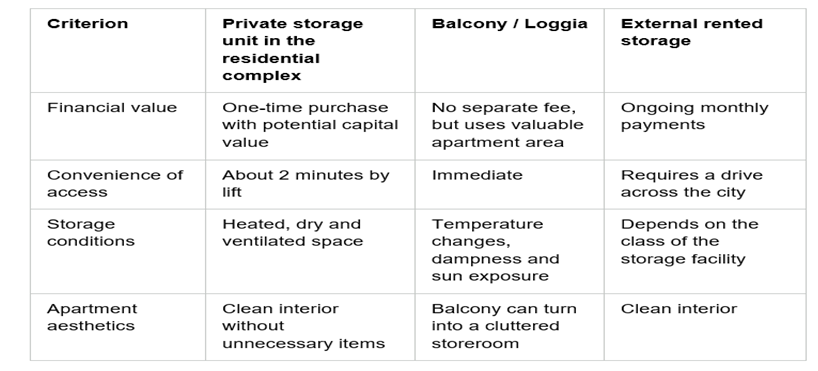
Comparison of Storage Options for Bulky Items
Each way of moving large belongings out of living rooms has advantages and disadvantages. A side-by-side comparison makes it easier to choose the most suitable option.
Storage Mistakes and How to Avoid Them
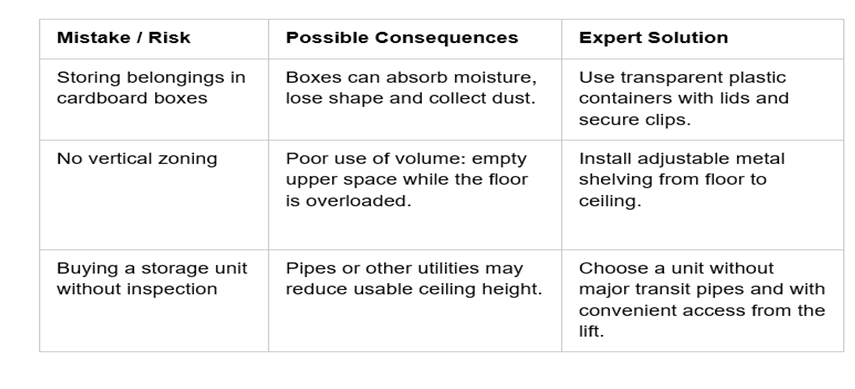
When organizing storage inside the apartment or in a separate storage room, homeowners often make similar mistakes that reduce efficiency. Knowing these risks in advance can prevent unnecessary expense and damage to belongings.
Checklist: How to Keep Your Apartment Organized
Use this checklist to assess whether your storage system is ready for long-term use:
● complete a full review of belongings and remove unused clutter;
● measure and prepare seasonal and bulky items that need to be relocated;
● choose and reserve an available storage unit in your residential complex;
● buy a consistent set of organizers, hangers and transparent containers;
● assign a permanent place to every small household category.
Completing each point consistently creates an organizational system that can last for years. You can then fine-tune the space around your own routines and priorities.
Read next
All publications